Scrum in one sentence
The 2020 Scrum Guide, written by Ken Schwaber and Jeff Sutherland, presents Scrum as a lightweight framework: a small team, short cycles, and continuous adaptation in the face of complex problems. The image behind the name comes from rugby: in 1986 Takeuchi and Nonaka compared the coordination of the fastest product development teams to a scrum (The New New Product Development Game).
Three accountabilities
The Guide speaks of accountabilities rather than roles, and there are three:
- The Developers create a usable Increment each Sprint. They are not necessarily software developers: they are the people who do the work.
- The Product Owner is accountable for the value of the product and orders the Product Backlog.
- The Scrum Master makes sure the framework is understood and applied, and helps the team remove impediments. Not a project manager, not a hierarchical superior.
Together they form the Scrum Team, which is typically ten people or fewer.
Five events
- The Sprint contains all the other events. Its length is one month or less.
- Sprint Planning (eight hours at most for a one-month Sprint) sets the Sprint Goal, the single objective of the cycle, and the work that leads to it.
- The Daily Scrum lasts fifteen minutes. The Developers adjust their plan for the day.
- The Sprint Review shows what is actually done to stakeholders, to get real feedback.
- The Sprint Retrospective (three hours at most for a one-month Sprint) examines how the team works and decides on an improvement.

Three artifacts, each with its commitment
The Product Backlog lists what could improve the product, with the Product Goal as its horizon. The Sprint Backlog is the subset chosen for the current cycle, with the Sprint Goal as its commitment. The Increment is what is done and usable, according to the "definition of done" the team sets itself.
What is common practice, not part of the framework
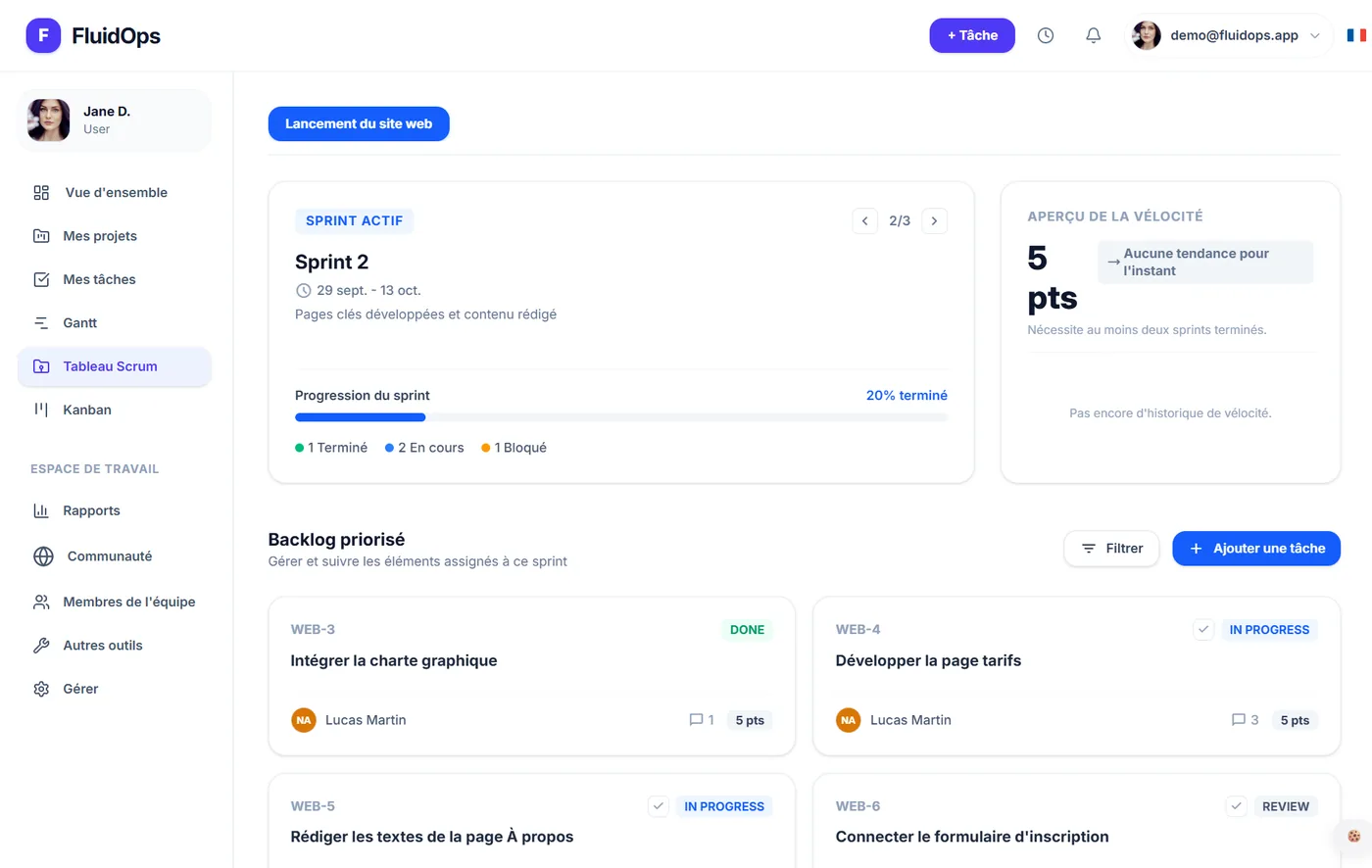
Velocity, story points and burndown charts are common in Scrum teams, but the word "velocity" does not appear in the Guide. You can use it to forecast, as long as you know it is a team choice and not a Scrum rule. The Guide also says that only the Product Owner can cancel a Sprint, and only if the Sprint Goal has become obsolete.
The most frequent traps
A Sprint longer than a month loses its feedback loop. A backlog nobody reorders stops guiding anyone. A retrospective that leads to no change wastes three hours. The question to ask at every event: what does the team know or decide afterwards that it did not know before?
Sources
- Schwaber, K., & Sutherland, J. (2020). The 2020 Scrum Guide. scrumguides.org
- Takeuchi, H., & Nonaka, I. (1986). The New New Product Development Game. Harvard Business Review, January 1986. hbr.org