A card between two workstations
In Toyota's factories, around the middle of the 20th century, a card (kanban, "signboard" or "tag" in Japanese) traveled between workstations. It told the upstream station to produce only what the downstream one had just consumed. David Anderson later adapted the idea to software development teams (Anderson, 2010), and it has since spread well beyond.

What the Kanban Guide says
The Kanban Guide (May 2025) boils the method down to three practices:
- Define and visualize the workflow. You draw the steps work actually goes through, not those of an ideal diagram.
- Actively manage items. A card that does not move is a signal: someone should be able to say why.
- Improve the flow. The board shows where things get stuck; you fix it in small steps.
The Guide adds one requirement: members explicitly control the number of items in progress, from start to finish. New work starts when there is capacity, not whenever the urge strikes. This is what is called a pull system.
Why limiting work in progress changes so much
Little's law links three quantities in a stable system: average work in progress equals average throughput multiplied by average time in the system (Little, 2011). At constant throughput, fewer cards in progress means cards that leave faster. A worked calculation is in our Kanban vs Scrum comparison.
A first board in one afternoon
- Write each task that is really in progress on a card. The rest waits in a "To do" column you do not look at every day.
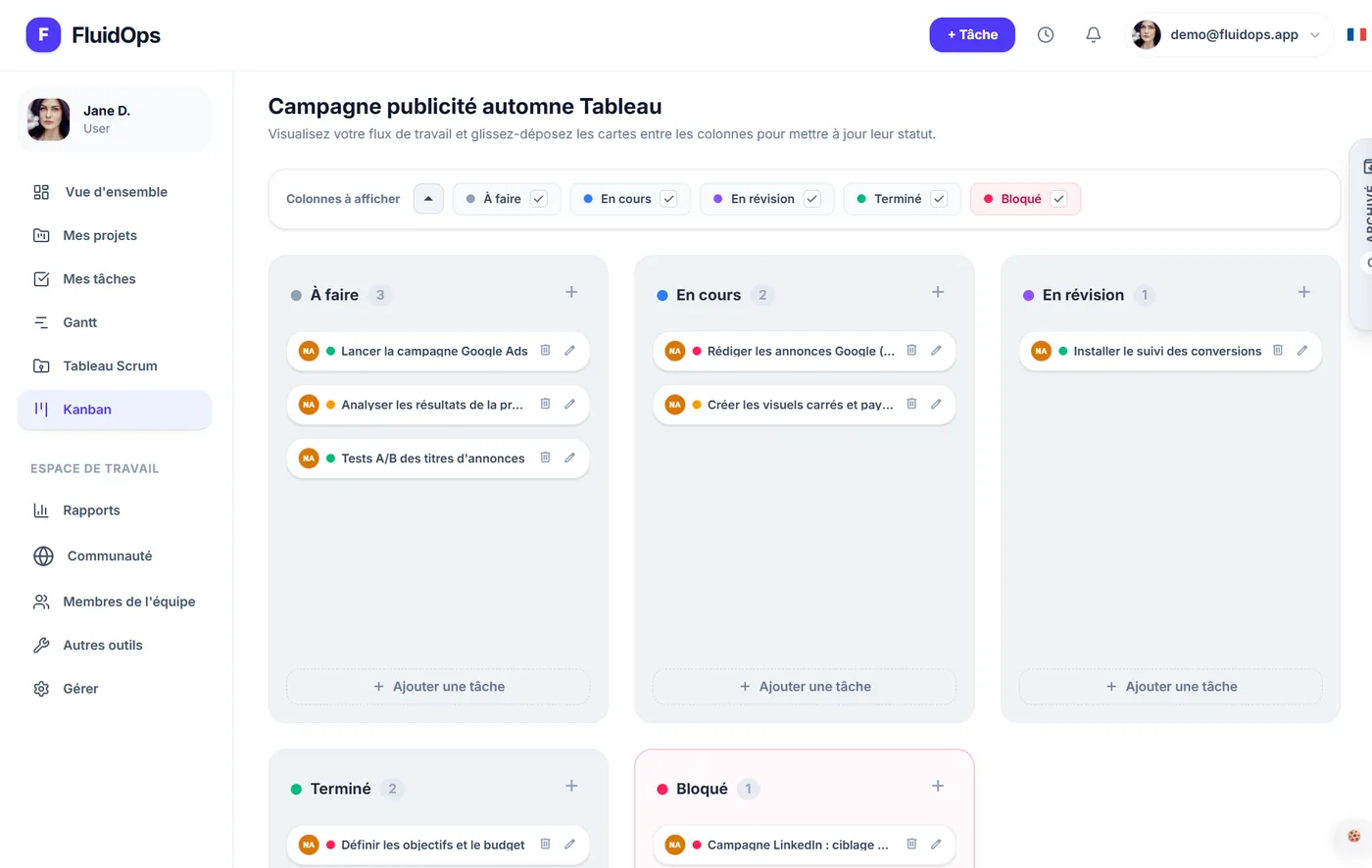
- Create three columns: to do, in progress, done. You will add "in review" or "blocked" once the need is confirmed.
- Cap "in progress" at two or three cards per person. It feels uncomfortable for the first two days, then you get used to it.
- Move cards as work happens, and set aside ten minutes a week to look at what stalled.
Three traps come up often: never applying the limit (the board turns into a list), never moving the cards (it describes the past), or using it only to report to someone else (the team stops looking at it).
Sources
- Coleman, J., Vacanti, D., et al. (2025). The Kanban Guide (May 2025). kanbanguides.org
- Little, J. D. C. (2011). OR Forum: Little's Law as Viewed on Its 50th Anniversary. Operations Research, 59(3), 536-549. doi:10.1287/opre.1110.0940
- Ahmad, M. O., Markkula, J., & Oivo, M. (2013). Kanban in software development: A systematic literature review. 39th EUROMICRO Conference on Software Engineering and Advanced Applications, 9-16. doi:10.1109/SEAA.2013.28
- Anderson, D. J. (2010). Kanban: Successful Evolutionary Change for Your Technology Business. Blue Hole Press.