Contents
- What is a Lightning Decision Jam?
- Why it works better than a classic brainstorm
- The 8 steps, with suggested timing
- Impact, effort and Quick Wins
- Pitfalls to avoid
- Running an LDJ remotely with FluidOps
- Frequently asked questions
What is a Lightning Decision Jam?
The Lightning Decision Jam (LDJ) is a short workshop, about an hour long, that takes a team from a vague complaint ("this isn't working") to a short list of decided actions, each with an owner and a deadline. It was popularized by the studio AJ&Smart, in the tradition of design sprint methods (Knapp, Zeratsky & Kowitz, 2016).
Its principle fits in one sentence: separate what is thought alone from what is decided together. Everyone writes in silence, the group votes, the facilitator keeps the frame. No open debate, no slide deck, no extra meeting that ends with "let's discuss it again".
Why it works better than a classic brainstorm
In a meeting, the idea of whoever speaks loudest or first ends up framing everything else. Research on group brainstorming also shows that people produce fewer ideas together than apart: they wait their turn, censor themselves, forget what they meant to say (Diehl & Stroebe, 1987).
The LDJ sidesteps these biases with three safeguards:
- Silent writing: everyone produces in parallel, without seeing the others' cards, so nobody is influenced.
- Individual voting: a limited number of votes per person surfaces what matters to the group, not to the chattiest person.
- Timeboxing: each step has a duration. The constraint forces choices.
The 8 steps, with suggested timing
Here is the flow as FluidOps offers it. Durations are guidelines: the facilitator adjusts them to the size of the group.
| Step | Suggested time | What you produce |
|---|---|---|
| 1. What works | 5 min | A list of positives, to warm up the team without debate |
| 2. Problems & irritants | 7 min | Everyone's problems, written in silence |
| 3. Vote on problems | 5 min | The most-voted problem(s) |
| 4. "How might we…" | 5 min | The chosen problem reframed as an open question |
| 5. Solutions | 10 min | Solutions proposed in silence for that question |
| 6. Vote on solutions | 5 min | The options that look most promising |
| 7. Impact / effort | 15 min | Each solution placed by impact and effort |
| 8. Action plan | 10 min | The Quick Wins, with a single owner and a deadline |
In total, you stay around one hour. The detail that changes everything: at step 4, the problem is reframed as "How might we…". "Customers complain about delays" becomes "How might we deliver faster without sacrificing quality?". The question opens up solutions instead of looking for someone to blame.
Impact, effort and Quick Wins
At step 7, each solution is rated on two axes: what it brings (impact) and what it costs (effort). High-impact, low-effort solutions are the Quick Wins: those are launched first. High-impact but very costly ones become projects to plan, and low-impact ones are dropped without regret. It is the same sorting logic as in the Pareto principle or the Eisenhower matrix.
At step 8, each Quick Win gets a single owner and a near deadline (14 to 30 days). An action that belongs to everyone belongs to no one.
Pitfalls to avoid
- Revealing cards too early. Until collection is over, each person should see only their own. Otherwise silence is pointless.
- Letting debate restart during votes. Voting is silent, and the facilitator breaks ties.
- Keeping too many problems. An LDJ handles one problem at a time. Several topics? Run several workshops.
- Ending without an owner. Without a name and a date at step 8, actions evaporate.
- Never coming back to it. Book ten minutes in two weeks to see what moved.
To anticipate what could make your actions fail before you launch them, you can follow up with a pre-mortem.
Running an LDJ remotely with FluidOps
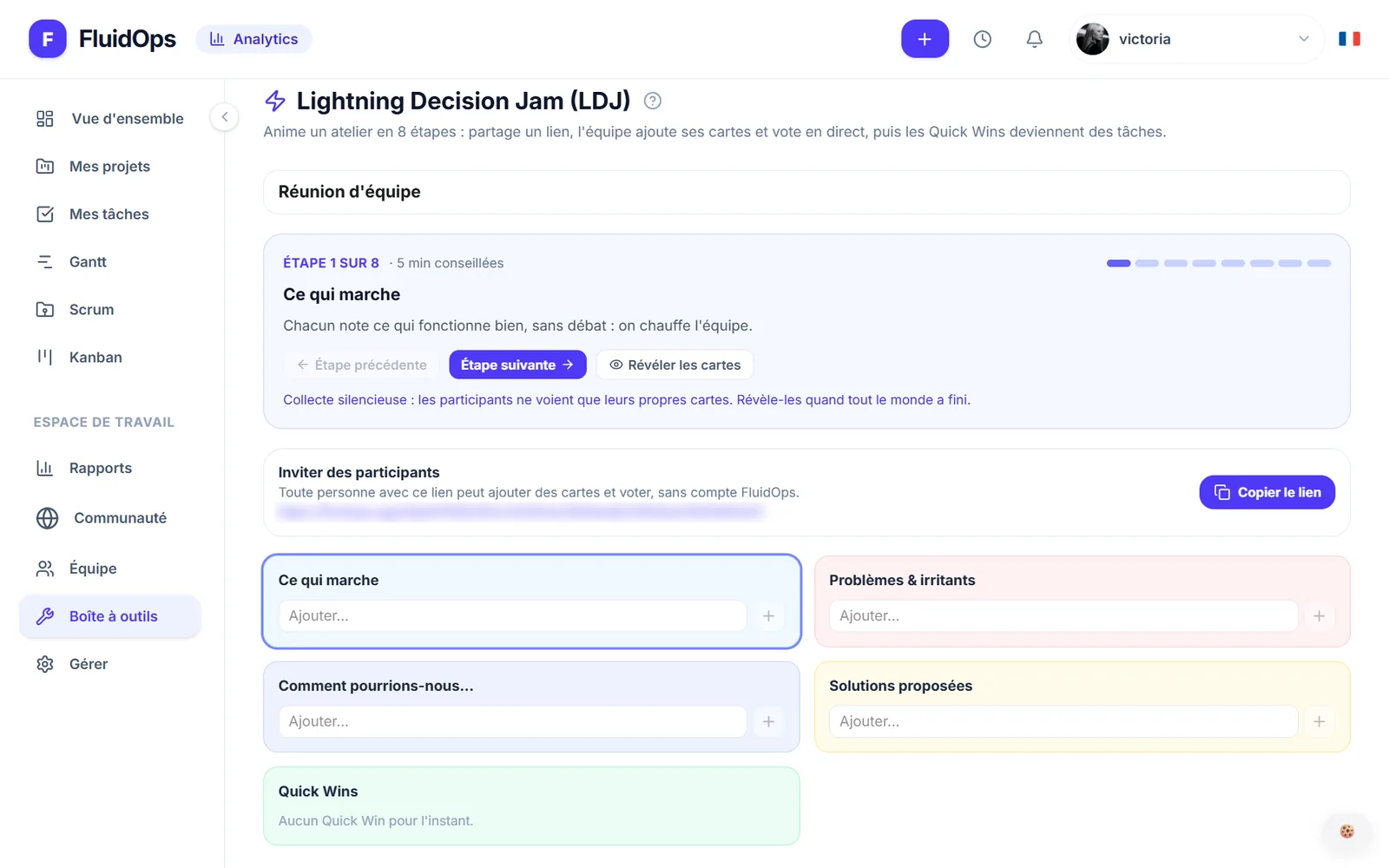
In the FluidOps toolbox, the LDJ runs right in the browser:
- The facilitator creates a session and shares a link. Participants join with a simple nickname, no account needed.
- Collection is silent: each participant sees only their own cards until the facilitator reveals them.
- Votes happen live, with an adjustable number of votes per person.
- A shared timer shows everyone the time left.
- Quick Wins can be sent as tasks to a project, with their owner and deadline.
You can then follow these actions in your Kanban board or Scrum sprints. To better set your schedules, see also the steps of project planning.
Frequently asked questions
How many people do you need for a Lightning Decision Jam?
The format works well with 4 to 12 people. Below that, a discussion is enough; above, votes and cards become hard to read and it is better to split into two groups.
Can it be done remotely?
Yes, and it is even comfortable: silent writing comes naturally on screen and everyone votes from their desk. You just need a tool that hides cards during collection.
How is it different from a brainstorm?
A brainstorm looks for ideas. The LDJ starts from a problem, forces reframing, selection by vote, and ends with assigned actions, each with an owner and a deadline.
Sources
- Diehl, M., & Stroebe, W. (1987). Productivity loss in brainstorming groups: Toward the solution of a riddle. Journal of Personality and Social Psychology, 53(3), 497-509.
- Knapp, J., Zeratsky, J., & Kowitz, B. (2016). Sprint: How to Solve Big Problems and Test New Ideas in Just Five Days. Simon & Schuster.
- AJ&Smart. Lightning Decision Jam (method guide, ajsmart.com).